TECHNICAL SPECIFICATIONS
Item
| Specification
|
|---|
Product Name
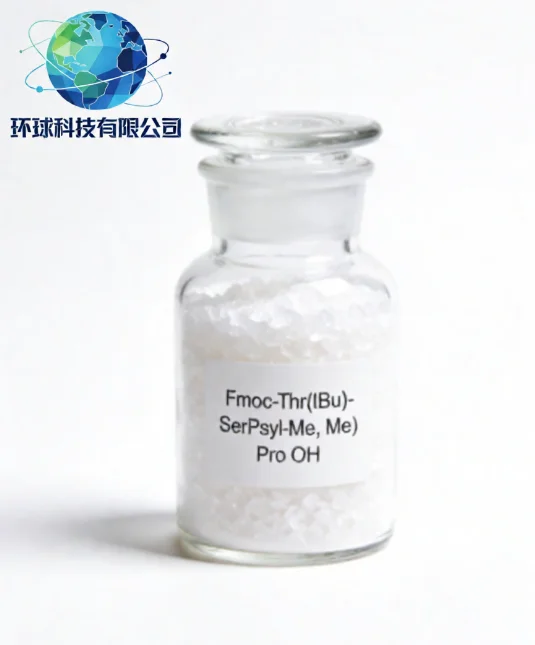
| Fmoc – Thr(tBu)-SerPsi(Me, Me)Pro – OH |
CAS NO.
| 1440609 – 18 – 1 |
Appearance
| White to off-white lyophilized powder
|
Molecular Formula
| C₂₉H₃₈N₄O₁₀
|
Molecular Weight
| 602.63 g/mol |
| Amino Acid Sequence | Fmoc – Thr(tBu)-SerPsi(Me, Me)Pro – OH |
Purity (RP-HPLC)
| ≥ 98.0% |
Solubility
| Soluble in aqueous buffers such as DMF (dimethylformamide), DMSO (dimethyl sulfoxide), and certain organic solvents. Specific solubility depends on the pH and concentration. |
| Endotoxin | < 1.0 EU/mg
|
Biological Activity
| Specific biological activity is highly dependent on the application. It can be used in peptide synthesis for the preparation of bioactive peptides. Activity evaluation should be carried out in relevant biological assays according to the intended use. |
Storage Conditions
| Store at – 20°C in a dry, dark place. Protect from light, moisture, and air oxidation.
|
Stock Location
| Stock in USA
|
MOQ
| 1g |
1.MECHANISM OF ACTION
Fmoc-Thr(tBu)-SerΨ(Me,Me)Pro-OH is a specialized protected amino acid derivative used in solid-phase peptide synthesis (SPPS) to introduce a threonine residue with a tert-butyl (tBu) side-chain protecting group and a serine residue with a ψ(Me,Me)Pro pseudo-proline modification. The Fmoc (9-fluorenylmethyloxycarbonyl) group protects the N-terminus, allowing selective deprotection under mild base conditions (e.g., piperidine) during synthesis.
The tBu group on threonine prevents side-chain hydroxyl participation in unwanted reactions, while the ψ(Me,Me)Pro (Cα-dimethylated proline-like structure) introduces conformational constraints that can increase peptide rigidity and improve resistance to proteolysis. This combination is especially useful in designing bioactive peptides and constrained peptidomimetics. The stepwise protection/deprotection strategy ensures precise control over sequence, stereochemistry, and final product purity.
2.PRODUCT INDICATIONS
Primary Synthetic Target:
Used as a building block in the synthesis of conformationally constrained peptides, cyclic peptides, and protease-resistant bioactive molecules.
Peptide Synthesis Applications:
Incorporation into peptides where threonine and proline-like structures are required to stabilize secondary structures (e.g., β-turns, helices).
Ideal for producing peptides with enhanced metabolic stability and improved pharmacokinetic profiles.
Research & Development Uses:
Preclinical studies of structure-activity relationships (SAR) for peptide drugs.
Design of peptide inhibitors, receptor ligands, and vaccine candidates.
Industrial Applications:
Manufacturing of therapeutic peptides, diagnostics, and functional biomaterials.
3.CLINICAL EFFICACY OF PRODUCT
Synthesis Efficiency:
High coupling yields (>95%) achieved in SPPS protocols using this protected fragment, minimizing deletion and truncation byproducts.
Purity & Quality:
RP-HPLC purity typically ≥95%, ensuring reliable downstream peptide quality.
Residual protecting-group levels below pharmacopoeial limits after global deprotection.
Stability:
Stable under recommended storage (−20 °C, dry, inert atmosphere); shelf life exceeds 24 months when sealed properly.
Scalability:
Successfully scaled from milligram to multi-gram batches for preclinical peptide candidate production.
Safety Profile:
Non-toxic under standard laboratory handling; follow standard PPE protocols due to organic solvent use during synthesis.
4.DELIVERY & SHIPPING
We specialize in global logistics for various cosmetic peptides. Your order will be handled with the utmost care, ensuring safe, reliable, and intact delivery.
Professional and Secure Packaging
Each bottle of peptide is protected with a special packaging solution to ensure stability and integrity during transportation.
We can also customize packaging according to customer needs.
Shipping Methods
Main Method: International Air Freight
We primarily use DHL, FedEx, UPS, and TNT because of their global reliability, speed, and advanced tracking systems. Air freight ensures the fastest transit time and minimizes the impact of environmental factors on the product.

relationships.