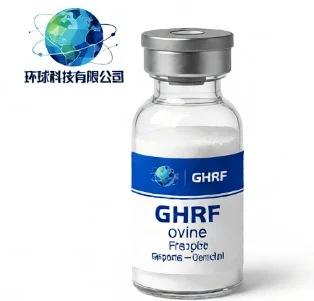
GHRF, ovine

TECHNICAL SPECIFICATIONS
| Item | Specification |
|---|---|
| Product Name | GHRF, ovine |
| CAS NO. | / |
| Appearance | White to off-white lyophilized solid powder |
| Molecular Formula | C221H368N72O66S |
| Molecular Weight | 5121.9g/mol |
| Purity (RP-HPLC) | ≥98.0% |
| Solubility | Soluble in water (≥5 mg/mL), dilute acetic acid (0.1% v/v) and DMSO |
| Endotoxin | ≤5.0 EU/mg EU/mg |
| Biological Activity | Selective agonist of ovine GHRHR (growth hormone-releasing hormone receptor) |
| Storage Conditions | Store at -20°C to -80°C in a sealed, desiccated container, protected from moisture and light. |
| Stock Location | Stock in USA |
| MOQ | 1g |
1.MECHANISM OF ACTION
Ovine GHRF functions by binding and activating the species-specific Growth Hormone-Releasing Hormone Receptor (GHRHR) on somatotroph cells in the ovine pituitary gland. The interaction with this G-protein coupled receptor (GPCR), primarily coupled to the Gs protein, triggers the activation of adenylate cyclase. This leads to a significant increase in intracellular cyclic adenosine monophosphate (cAMP) levels.
- Ruminant Physiology Research: Investigating the hypothalamic-pituitary-somatotropic axis, GH pulsatility, and feedback mechanisms in sheep and related species.
- Agricultural & Animal Science: Studying the endocrine control of growth, lactation, metabolism, and body composition in livestock for potential applications in animal husbandry and production.
- Comparative Endocrinology: Analyzing structural and functional differences in GHRH peptides and their receptors across species (e.g., ovine vs. human vs. bovine).
- In VivoAnimal Studies: Administering to sheep to experimentally elevate GH levels for research on growth performance, nutrient partitioning, and wool production.
- In VitroPituitary Studies: Using primary ovine pituitary cell cultures to study the direct effects on GH secretion and somatotroph cell function.
- Veterinary Endocrinology: Serving as a tool for understanding endocrine disorders and for the development of diagnostic assays specific to ovine species.
2.PRODUCT INDICATIONS
- Research & Physiological Efficacy: In ovine models, it is highly effective in stimulating a robust, dose-dependent release of growth hormone, making it a validated tool for experimental manipulation of the GH axis.
- Agricultural Relevance: Research using ovine GHRF has historically contributed to understanding the endocrine drivers of growth and efficiency in sheep, informing strategies for genetic selection and management. However, its use is not practical for commercial farming.
- Diagnostic Prototype: It has been used in research settings to develop GH stimulation tests for sheep, aiding in the study of pituitary function.
- Therapeutic Gap: It is not developed or approved as a therapeutic agent. Commercial applications for enhancing growth in livestock have focused on other technologies (e.g., recombinant bovine GH for cattle). Its value remains in basic and translational research.
3.CLINICAL EFFICACY OF PRODUCT
4.DELIVERY & SHIPPING
We specialize in global logistics for various cosmetic peptides. Your order will be handled with the utmost care, ensuring safe, reliable, and intact delivery.
Professional and Secure Packaging
Each bottle of peptide is protected with a special packaging solution to ensure stability and integrity during transportation.
We can also customize packaging according to customer needs.
Shipping Methods
Main Method: International Air Freight
We primarily use DHL, FedEx, UPS, and TNT because of their global reliability, speed, and advanced tracking systems. Air freight ensures the fastest transit time and minimizes the impact of environmental factors on the product.

What Is The Function Of Somatocrinin?
Somatocrinin, more commonly known as growth hormone–releasing hormone (GHRH), is a key regulatory peptide produced in the hypothalamus that plays a central role in controlling the secretion of Growth Hormone from the anterior pituitary gland. Its primary function is to stimulate the synthesis and release of growth hormone (GH), which is essential for normal growth, metabolism, and tissue repair.
Somatocrinin is released into the hypothalamic–pituitary portal circulation and travels to the anterior pituitary, where it binds to specific receptors on somatotroph cells. This interaction triggers intracellular signaling pathways that promote both the production and pulsatile secretion of growth hormone. The release of somatocrinin itself is tightly regulated by various physiological factors, including sleep, stress, nutrition, and blood glucose levels.
One of the major downstream effects of growth hormone stimulated by somatocrinin is the production of insulin-like growth factor 1 (IGF-1) in the liver and other tissues. IGF-1 mediates many of the growth-promoting actions of GH, such as increasing protein synthesis, stimulating bone and cartilage growth, and enhancing muscle development. In addition, growth hormone influences fat metabolism by promoting lipolysis, thereby helping regulate body composition.
Somatocrinin works in balance with another hypothalamic hormone called Somatostatin, which inhibits growth hormone release. The interplay between these two hormones ensures that GH secretion remains appropriately regulated according to the body’s needs.
In summary, somatocrinin functions as a crucial upstream signal in the endocrine system, coordinating the release of growth hormone and thereby influencing growth, metabolism, and overall physiological balance.
What Is The Difference Between Somatotropin And Somatocrinin?
The difference between Somatotropin and Somatocrinin lies mainly in where they are produced, how they function, and their roles within the endocrine system.
Somatocrinin, also known as growth hormone–releasing hormone (GHRH), is produced in the hypothalamus, a region of the brain that regulates many hormonal processes. Its primary role is to act as a signaling hormone. It travels through the hypothalamic–pituitary portal system to the anterior pituitary gland, where it stimulates specialized cells called somatotrophs to synthesize and release somatotropin. In other words, somatocrinin does not directly cause growth; instead, it triggers the release of another hormone that does.
Somatotropin, on the other hand, is the actual growth hormone (GH) produced and secreted by the anterior pituitary gland. Once released into the bloodstream, somatotropin acts directly on various tissues throughout the body. It promotes linear growth in bones during childhood and adolescence, increases protein synthesis, supports muscle development, and influences metabolism by enhancing fat breakdown and reducing glucose uptake in certain tissues. Many of its growth-promoting effects are mediated through insulin-like growth factor 1 (IGF-1), which is produced בעיקר in the liver in response to GH stimulation.
Another key difference is their regulatory relationship. Somatocrinin stimulates the release of somatotropin, while another hypothalamic hormone, Somatostatin, inhibits it. This creates a feedback-controlled system that maintains appropriate growth hormone levels depending on physiological needs such as sleep, nutrition, and stress.
In summary, somatocrinin is a regulatory hormone that signals the pituitary gland to release growth hormone, whereas somatotropin is the active hormone that directly affects growth, metabolism, and tissue development.
What is GRF Hormone?
Growth Hormone–Releasing Factor (GRF), also known as growth hormone–releasing hormone (GHRH) or Somatocrinin, is a peptide hormone produced by the hypothalamus that plays a central role in regulating the endocrine system. Its primary function is to stimulate the synthesis and secretion of Growth Hormone from the anterior pituitary gland.
GRF is released in a pulsatile manner from specialized neurons in the hypothalamus and enters the hypothalamic–pituitary portal circulation, a network of blood vessels that directly connects the hypothalamus to the pituitary gland. When GRF reaches the anterior pituitary, it binds to specific receptors on somatotroph cells. This binding activates intracellular signaling pathways, particularly those involving cyclic AMP (cAMP), which ultimately lead to increased production and release of growth hormone.
The secretion of GRF is influenced by multiple physiological factors. For example, deep sleep, physical exercise, stress, and low blood glucose levels tend to stimulate its release, while high levels of growth hormone or insulin-like growth factor 1 (IGF-1) provide negative feedback to suppress it. GRF also works in coordination with Somatostatin, another hypothalamic hormone that inhibits growth hormone release. The balance between GRF and somatostatin ensures that growth hormone secretion is tightly regulated.
Through its stimulation of growth hormone, GRF indirectly influences many important biological processes, including linear growth in children, protein synthesis, fat metabolism, and overall energy balance. Abnormalities in GRF production or signaling can contribute to growth disorders, such as growth hormone deficiency or excess.
In summary, GRF is a key upstream regulator in the hormonal control of growth, acting as the signal that prompts the pituitary gland to release growth hormone and maintain normal physiological development.