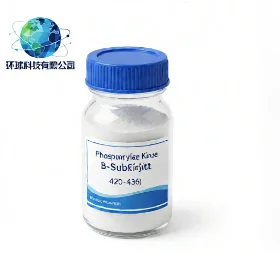
Phosphorylase Kinase b-Subunit Fragment (420-436)

TECHNICAL SPECIFICATIONS
| Item | Specification |
|---|---|
| Product Name | Phosphorylase Kinase b-Subunit Fragment (420-436) |
| CAS NO. | / |
| Appearance | White to off-white lyophilized powder |
| Molecular Formula | C79H130N31O25S |
| Molecular Weight | 1946.2g/mol |
| Purity (RP-HPLC) | ≥ 95.0% |
| Solubility | Soluble in water, 0.1% TFA, or dilute aqueous buffers (up to 10 mg/mL) |
| Endotoxin | ≤1.0 EU/mg |
| Biological Activity | Serves as a specific substrate for phosphorylase kinase; used to measure kinase activity in enzymatic assays and validate antibody recognition |
| Storage Conditions | Store at -20°C; stable for 24 months when desiccated. Avoid repeated freeze-thaw cycles. |
| Stock Location | Stock in USA |
| MOQ | 1g |
1.MECHANISM OF ACTION
This peptide fragment does not possess intrinsic enzymatic activity. Instead, it functions as a molecular probe or regulator that interacts with specific components of the PhK complex or its modulators. The beta subunit of PhK acts as both a substrate for PKA (Protein Kinase A) phosphorylation and a regulatory module.
- Enzyme Regulation Studies: Investigating the molecular mechanism of calcium/calmodulin activation of Phosphorylase Kinase by using the peptide as a competitive inhibitor or probe in in vitroactivation assays.
- Antibody Production: Conjugating the peptide to a carrier protein to generate polyclonal or monoclonal antibodies specific to this region of the PhK beta subunit for use in Western blotting, immunohistochemistry, or immunoprecipitation.
- Phosphorylation Site Analysis: Studying the kinetics and consequences of phosphorylation within this specific region by PKA or other kinases, using the peptide as a simplified model substrate.
- Protein-Protein Interaction Mapping: Utilizing the peptide in pull-down assays, surface plasmon resonance (SPR), or isothermal titration calorimetry (ITC) to map its interaction with calmodulin or other regulatory proteins.
- Structure-Function Analysis: Employing the peptide in studies aimed at understanding how this specific segment contributes to the overall regulatory function of the PhK beta subunit.
- Metabolic Disorder Research: Serving as a tool to dissect PhK dysfunction in glycogen storage diseases (like some forms of PhK deficiency) at a molecular level.
2.PRODUCT INDICATIONS
- Research Tool Efficacy: Its "efficacy" lies in its utility as a precise molecular tool to dissect the complex regulation of Phosphorylase Kinase, a central enzyme in energy metabolism. It enables high-resolution studies not possible with the full, multi-subunit holoenzyme.
- Disease Research Context: Phosphorylase Kinase deficiencies are known causes of glycogen storage diseases (e.g., some forms of liver and muscle glycogenosis). Research using such specific fragments helps elucidate the molecular defects (e.g., impaired calmodulin binding, altered phosphorylation) underlying these genetic disorders.
- Therapeutic Target Insight: While PhK itself is not a direct drug target, understanding its regulation is crucial for broader metabolic research. Insights into calcium/calmodulin-mediated enzyme activation can inform research into other signaling pathways relevant to metabolic syndrome, diabetes, and cardiac hypertrophy.
- Clinical Translation Gap: The peptide itself is not a drug candidate. Its value is in generating fundamental knowledge about a critical metabolic enzyme, which may indirectly inform the understanding of related pathologies or signaling networks.
3.CLINICAL EFFICACY OF PRODUCT
4.DELIVERY & SHIPPING
We specialize in global logistics for various cosmetic peptides. Your order will be handled with the utmost care, ensuring safe, reliable, and intact delivery.
Professional and Secure Packaging
Each bottle of peptide is protected with a special packaging solution to ensure stability and integrity during transportation.
We can also customize packaging according to customer needs.
Shipping Methods
Main Method: International Air Freight
We primarily use DHL, FedEx, UPS, and TNT because of their global reliability, speed, and advanced tracking systems. Air freight ensures the fastest transit time and minimizes the impact of environmental factors on the product.