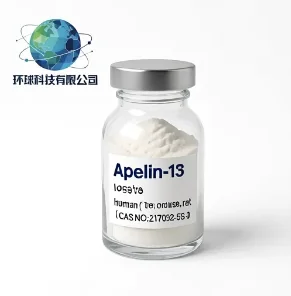
Apelin-13 (human, bovine, mouse, rat) CAS NO.217082-58-1

TECHNICAL SPECIFICATIONS
| Item | Specification |
|---|---|
| Product Name | Apelin‑13 (human, bovine, mouse, rat) |
| CAS NO. | 217082‑58‑1 |
| Appearance | White to off-white lyophilized powder |
| Molecular Formula | C₆₉H₁₀₈N₂₂O₁₅S |
| Molecular Weight | 1654.80g/mol |
| Purity (RP-HPLC) | ≥ 95.0% |
| Solubility | Soluble in water (≥5 mg/mL); soluble in 5% acetic acid or DMSO |
| Endotoxin | < 1.0 EU/mg |
| Biological Activity | Potent and endogenous agonist for APJ receptor; improves cardiac contractility, induces vasodilation, regulates fluid homeostasis, angiogenesis and energy metabolism. |
| Storage Conditions | Store at ‑20°C; long‑term at ‑80°C. Protect from light and moisture. Avoid repeated freeze‑thaw cycles. |
| Stock Location | Stock in USA |
| MOQ | 1g |
1.MECHANISM OF ACTION
- Cardiovascular System (Predominantly Gi/o Coupling):
- Vasodilation: Activates endothelial Gi/o proteins, leading to eNOS phosphorylation, nitric oxide (NO) production, and vasodilation. It also antagonizes Angiotensin II signaling, opposing the Renin-Angiotensin System (RAS).
- Positive Inotropy: In the heart, it increases contractility through mechanisms that may involve both Gi and Gq pathways, enhancing cardiac output without increasing heart rate.
- Central Nervous System: In the hypothalamus, it modulates fluid intake (reduces thirst), appetite, and neuroendocrine axes via APJ receptors.
- Metabolism: In adipose tissue, it enhances glucose uptake and insulin sensitivity.
- Angiogenesis: Promotes new blood vessel formation.
2.PRODUCT INDICATIONS
- Cardiovascular Research: Investigating its role as a vasodilator, inotropic agent, and cardioprotective factor in models of hypertension, heart failure, myocardial infarction, and pulmonary arterial hypertension.
- Metabolism & Diabetes Research: Studying its effects on insulin sensitivity, glucose disposal, and adipose tissue function in models of obesity and type 2 diabetes.
- Neuroscience: Exploring central roles in body fluid homeostasis (dipsogenesis), feeding behavior, neuroprotection, and mood disorders.
- Angiogenesis & Cancer: Researching its pro-angiogenic effects in both physiological repair and pathological contexts like tumor growth.
- Drug Discovery: Serving as the reference standard agonist for screening novel APJ receptor modulators (agonists/antagonists).
3.CLINICAL EFFICACY OF PRODUCT
- Cardiovascular Therapeutics: Preclinical studies consistently show Apelin-13 can lower blood pressure, improve cardiac function in heart failure, and protect the heart from ischemic injury. Early human clinical trials (Phase I/IIa) in patients with heart failure have demonstrated that intravenous Apelin-13 infusion produces potent peripheral and coronary vasodilation, increases cardiac output, and reduces preload and afterload with a favorable safety profile. It represents a promising novel therapy for acute heart failure.
- Metabolic Disease Target: Its insulin-sensitizing effects in animals highlight its potential for treating metabolic syndrome and type 2 diabetes.
- Validated Target: Research with Apelin-13 has been instrumental in validating the APJ receptor as a major therapeutic target, leading to significant investment in developing stable APJ agonists for cardiovascular and metabolic diseases.
4.DELIVERY & SHIPPING
We specialize in global logistics for various cosmetic peptides. Your order will be handled with the utmost care, ensuring safe, reliable, and intact delivery.
Professional and Secure Packaging
Each bottle of peptide is protected with a special packaging solution to ensure stability and integrity during transportation.
We can also customize packaging according to customer needs.
Shipping Methods
Main Method: International Air Freight
We primarily use DHL, FedEx, UPS, and TNT because of their global reliability, speed, and advanced tracking systems. Air freight ensures the fastest transit time and minimizes the impact of environmental factors on the product.